Green Knight
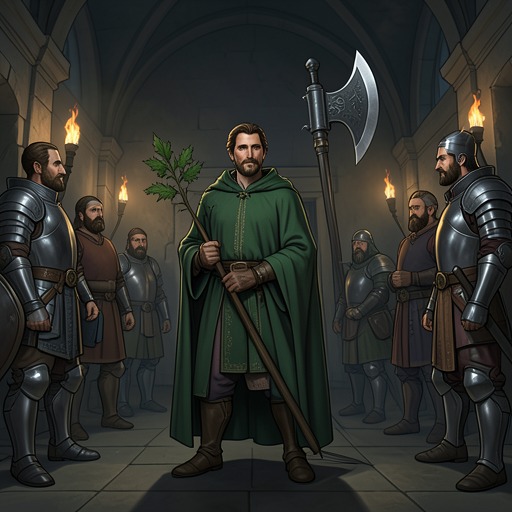
Sir Gawain and the Green KnightThe Green Knight is both the unnerving stranger who disrupts King Arthur’s feast and the host who finally confronts Sir Gawain at the Green Chapel. His decisive role is to bind those encounters together: what first appears as a marvel at court becomes, through the later revelation that he is Bertilak de Hautdesert, a deliberately arranged test of Gawain’s conduct and promises.
Identity and Introduction
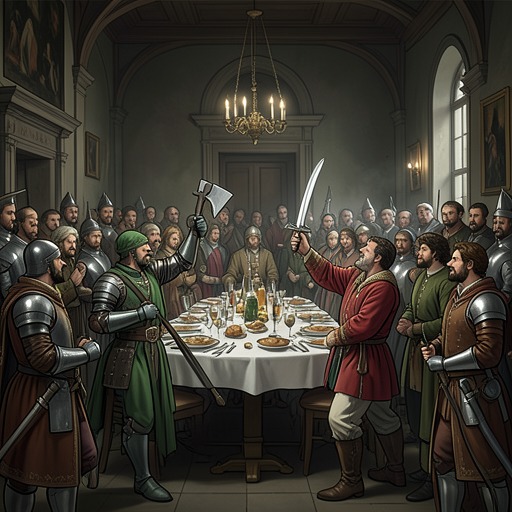
The poem presents the Green Knight within a story of Arthurian wonders, announcing an adventure associated with King Arthur’s celebrated court. He enters just as the hall’s first course has been served. The narration marks him as an uncanny master, immense in stature and powerfully built from neck to waist; his appearance makes the interruption feel less like an ordinary visitor’s arrival than a challenge to the court’s sense of what is possible.
The image that fixes his strangeness is his handling of his own severed head. Holding it upright, he turns its face toward the most honored person on the dais; the head lifts its eyelids and looks widely across the hall. The gesture makes the Green Knight more than a formidable body: even apparent decapitation does not end his agency. The court’s astonishment is therefore answered by an impossible act, and the figure who brought the marvel remains able to direct attention and demand a response.
Challenge and the Return of the Agreement
When Sir Gawain approaches him with a weapon in hand, the Green Knight speaks before they proceed, insisting that they renew their agreement. The request gives their encounter the shape of a continuing obligation rather than a single display of force. His words place the terms between them in the foreground: before anything further happens, Gawain is to recognize that a promise already made still governs what follows.
The later meeting at the Green Chapel confirms that the Green Knight has kept this agreement in view. He welcomes Gawain as a man who has timed his journey faithfully, acknowledging the effort of reaching the appointed place. The greeting is cordial, but its warmth does not dissolve the stakes: the Green Knight has brought Gawain to the moment at which their earlier arrangement must be answered. Courtesy and judgment occupy the same scene.
Bertilak and the Household Test
Before the identity is disclosed, the Green Knight’s conduct as a host establishes another part of his role. He laughs when Gawain speaks of his short remaining time and says that Gawain must stay longer, promising to guide him to the Green Chapel when the appointed time arrives. The reassurance offers rest and direction, turning the journey toward a dangerous meeting into a period of hospitality under the host’s control.
That hospitality is governed by an exchange agreement. The Green Knight proposes that whatever he wins in the woods will belong to Gawain, while whatever Gawain obtains is to be exchanged in return. The rule makes ordinary gains and social obligations part of the same test. At the household, Gawain is also publicly called forward and shown the venison: the host teaches him about the animals’ tails and points out the carefully cut fat on their ribs. These concrete displays of hunting and preparation give the exchange a visible, material form.
The Green Knight’s later explanation connects the household test to the green girdle Gawain wears. He identifies it as a woven belt made by his wife and says that he knows Gawain’s kisses and conduct. The revelation makes clear that he was not an uninformed observer of what took place in his household: he can judge Gawain’s actions against the terms of their exchange. The girdle matters because Gawain kept it, and because the Green Knight names its origin and links it to what he knows.
Revelation and Narrative Significance
At the end of the encounter, the Green Knight answers a direct question about his name by identifying himself as Bertilak de Hautdesert. He also states that Morgan le Fay’s power was involved, and that she lives in his house. This disclosure changes the meaning of his earlier appearances. The terrifying visitor, the hospitable lord, and the judge at the Green Chapel are not separate figures but one character acting across the apparent divide between courtly welcome and supernatural ordeal.
His role depends on that double presence. At court, the severed head makes him an embodied impossibility; in the household, agreements and exchanges measure Gawain through ordinary acts of giving and receiving. At the Green Chapel, the Green Knight brings the two registers together, greeting Gawain as a faithful traveler while exposing what the household test has revealed. The identity disclosure does not erase the wonder of his first appearance. It supplies a human name and a connection to Morgan le Fay without making his earlier survival or his command over the test any less extraordinary.